
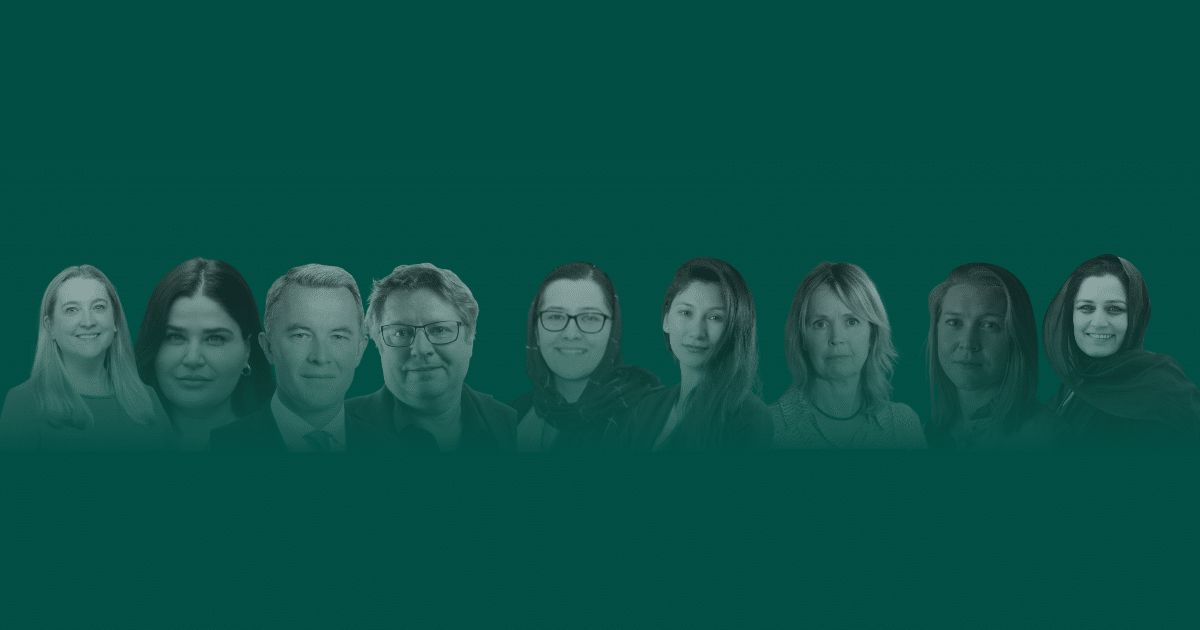
Five years after the Taliban returned to power, Afghanistan Week 2026 opens in Oslo on Tuesday 27 October. For one evening, the Norwegian government, Ireland as holder of the EU Council Presidency, the UN mission in Afghanistan and leading Afghan experts share one stage. Together they take on the question that runs through the whole week: if current approaches are not delivering, what should we do differently?
Since 2014, Afghanistan Week has grown into one of the largest international meeting places on Afghanistan. This year, more than ten events over four days bring together policymakers, diplomats, researchers, artists and Afghan voices from inside and outside the country. The opening is the main event of the week and sets the direction for the discussions that follow.
Beyond the stalemate
For five years, the international debate on Afghanistan has been stuck between two positions: talk to the Taliban, or keep them at a distance. Neither has changed Taliban policy. Girls are barred from secondary school and university, and women are shut out of most work and public life. Meanwhile, contact with the Islamic Emirate is becoming normal. Regional powers engage pragmatically, and several Western governments are moving towards de facto normalisation, partly to manage migration. Humanitarian needs are growing while aid budgets shrink, and millions of Afghans forced back from Iran and Pakistan are adding to the pressure.
The opening is built to move this debate forward. The first panel tests both approaches against what they have actually delivered. The second gives Afghan experts the floor to set out what lies beyond the choice between dialogue and distance, and what they want the politicians in the room to do differently.
Programme
The evening opens with a speech by Liv Kjølseth, Secretary General of the Norwegian Afghanistan Committee. Charity Watson, UNAMA’s Climate, Peace and Security Advisor, then gives a statement on behalf of the UN Special Representative for Afghanistan. She has worked in Afghanistan for more than ten years.
High-level panel: Dialogue or distance?
Norway and Ireland both sat on the UN Security Council when Kabul fell in 2021, and have since drawn different conclusions. Norway has kept a channel of dialogue open, in line with its principle of talking to all parties in a conflict. Ireland has warned against contact that normalises the regime and has backed international accountability. State Secretary Andreas Motzfeldt Kravik and Ambassador Claire Buckley will discuss what each approach has achieved for girls’ education, women’s rights and humanitarian access. They will also discuss whether dialogue and pressure can work side by side. The panel is moderated by Nasrin Naimy, Senior Political Advisor at the Norwegian Afghanistan Committee.
Cultural segment
A new poem by Dr Samay Hamed, head of Afghan PEN in exile, written to mark five years since the Taliban takeover, will be presented by Hasina Shirzad and Elisabeth Eide of PEN Norway’s Afghanistan Committee.
Afghan perspectives: beyond dialogue or distance
Three Afghan experts take stock of what Taliban rule has done to Afghan society, especially to women and girls, and what has changed inside the country that rarely reaches the international debate. They will then present their proposals for the way forward, including where Afghan women can have the most impact.
- Dr. Orzala Ashraf Nemat, who has led the Afghan think tank AREU and was a Yale World Fellow
- Fereshta Abbasi, researcher in Human Rights Watch’s Asia division
- Zuhra Bahman, who leads Search for Common Ground in Afghanistan and has worked on peacebuilding and women’s rights for more than 20 years
The panel is moderated by Arne Strand, Senior Researcher at the Chr. Michelsen Institute.
Practical information
Date: Tuesday 27 October 2026
Time: 18:00–19:30
Place: Henry Dunant Hall, Norwegian Red Cross (Røde Kors-huset), Hausmanns gate 5, Oslo
More from Afghanistan Week 2026
Afghanistan Week runs from 26 to 29 October across central Oslo. The programme covers climate and security, China’s role in Afghanistan, Taliban rule, women’s access to justice, higher education and young Afghan entrepreneurs. It also features internationally acclaimed artists Aziz Hazara and Amanullah Mojadidi in conversation, and a screening of 25 Years in Afghanistan, the new version of the BAFTA-winning documentary My Childhood, My Country.
See the full programme here.


