
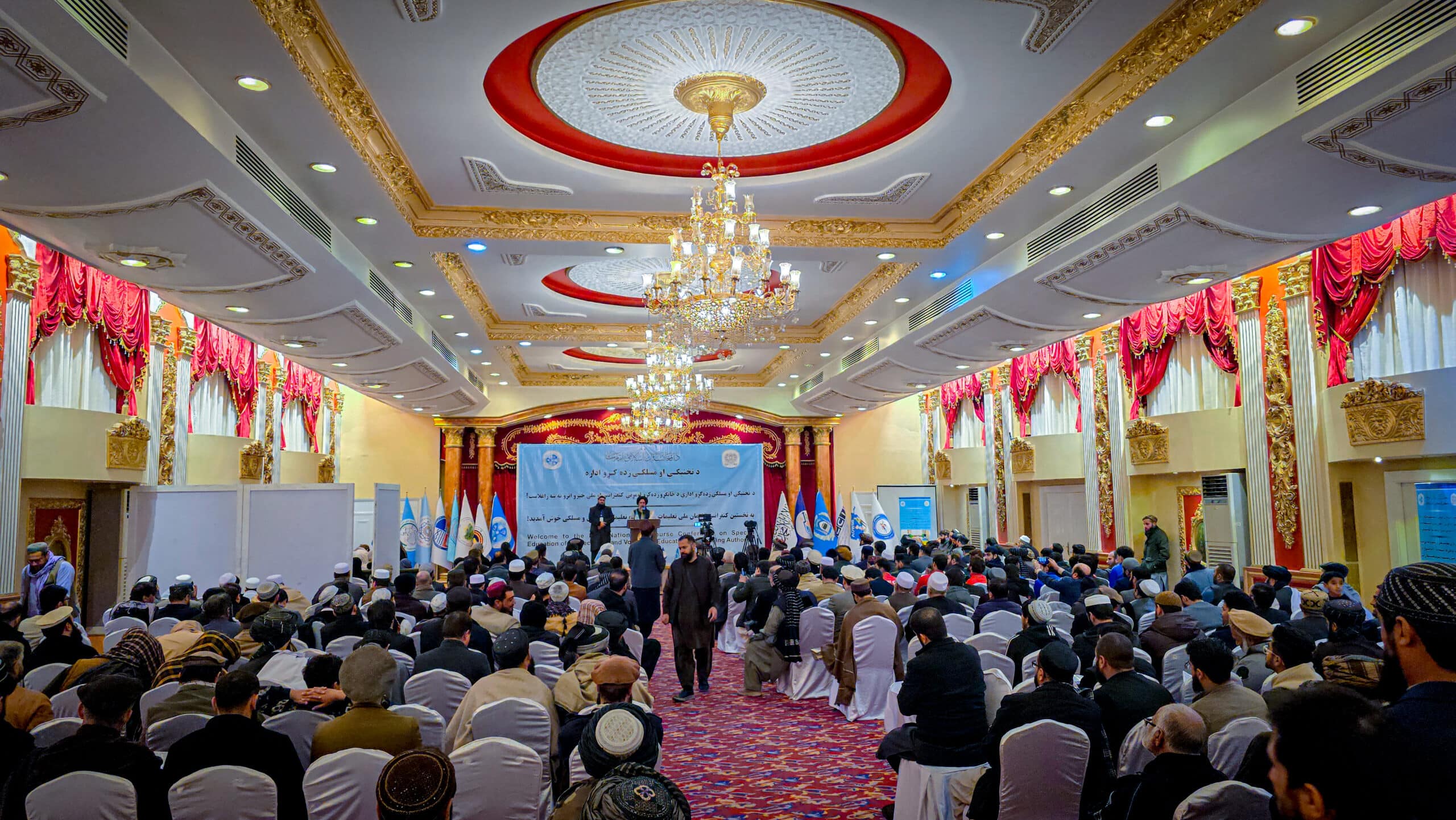
On 3rd and 4th December 2025, the Technical and Vocational Education and Training Authority (TVET-A) and the Norwegian Afghanistan Committee (NAC) co-hosted a National Dialogue on Special Education to mark the International Day of Persons with Disabilities.
The conference brought together high-ranking representatives from 20 ministries and authorities, UN agencies, the International Committee of the Red Cross (ICRC), the Afghan Red Crescent Society, international organisations working in the field of disability inclusion, representatives from Afghan civil society and members of organisations of persons with disabilities.
The participation exceeded the expectations as 500 people attended the main sessions on the first day and about 160 joined the working groups on the second day.
The National Dialogue aimed to open the way to unified coordination, collaboration and coherence between the various stakeholders and public institutions to centre rights and needs of persons with disability both in policy making and programme design.
There was a common agreement to consider Disability Inclusion as a cross-cutting topic that needs engagement and commitment beyond sector-specific initiatives and actors. Several of the Government representatives in their opening remarks stressed the importance of joining forces to mitigate the challenges that persons with disability face. Abdul Ghafar Momand, President of the Afghanistan National Organisation of the Deaf (ANOD), clearly highlighted a guiding point that informed much of the discussions during the National Dialogue: that is, persons with disabilities need education and employment opportunities to become self-reliant and be able to serve their communities rather than being marginalised and excluded to become a burden for society.
To promote this transversal approach, the core activity of the National Dialogue was the organisation of four different working groups focussing on Education, Social Affairs, Economic Inclusion and Legislative Reform. Participants in the working groups represented both civil society organisations and governmental officials. A fifth working group gathered more than 40 representatives of national and international organisations as well as UN agencies.
The main recommendations from the working groups include:
- To pass a national legislation with specific provisions for persons with disabilities.
- To strengthen building codes to ensure that all public buildings will become more accessible for persons with disabilities.
- To fast-track approval processes (e.g., MoUs) for programmes targeting persons with disabilities and disabling health conditions.
- To promote and support social entrepreneurship of persons with disabilities.
- To encourage I-NGOs and government bodies to hire more persons with disabilities as well as facilitate dedicated internship programmes.
- To enhance multilateral coordination with TVET as a central actor for special needs and vocational training education for persons with disabilities.
- To work on capacity building of teachers in special needs education and to include Sign language in Ministry of Education curricula.
- To expand the Sign language video dictionary with NAC’s support.
- To develop new curricula for primary and secondary education programmes for persons with disabilities with NAC’s support.
- To facilitate access to higher education for persons with disabilities.
- To provide access to dedicated public health services for persons with disabilities.
- To facilitate improved access to Hajj for persons with disabilities (e.g., financial support and introduction of a quota system).
The international working group agreed on the following shared commitments:
- To practice affirmative action in recruitment and employment of persons with disabilities – Mappings will be conducted in coordination with ACBAR.
- To make all the necessary changes for national and international organisations’ office spaces to be more accessible – Mappings will be conducted in coordination with ACBAR.
- To conduct research and studies related to Disability Inclusion in close coordination with organisations of persons with disabilities (OPDs), TVET-A, and other relevant authorities.
- To join, revive, and strengthen the Disability Inclusion Working Group.
- To include OPDs and relevant government ministries, authorities, and institutions in all programme design.
The international working group also presented the following recommendations:
- To work towards the integration of Physical Rehabilitation into the Public Health system, especially the Basic Package of Health Services (BPHS) and the Essential Package of Hospital Services (EPHS).
- To jointly develop dedicated maternal health programmes for women with disabilities.
- To develop vocation education and training programmes targeting women and adolescent girls with disabilities and disabling health conditions.
- To expand training opportunities for prosthetics and orthotics technicians within TVET-A structure.
- To allow registration of organisations of persons with disabilities with the Ministry of Justice (MOJ).
- To jointly provide special trainings to Ulema Councils, mosques, online and print media, Radio and TV journalists, GDI, Ministry of Interior’s staff to support and raise community awareness on disability inclusion.
- To impose strict construction regulations to guarantee that all new buildings are accessible for persons with disabilities.
The National Dialogue proved to be an important milestone both at a national and at an international level as it fostered a rare transversal synergy to concentrate political and civil society efforts for the active engagement and promotion of persons with disabilities in all aspects of life and society.
While there was a common agreement that this is only the beginning of a journey that requires time and great dedication, a few practical steps were taken towards its realisation:
- All cabinet ministers expressed their support to the initiative and emphasised that the outcomes of the conference must be implemented.
- All cabinet ministers agreed that there will be no discrimination between persons born with disabilities; those who develop disabilities in their childhood, adolescence, and adulthood; and those whose disabilities are the result of conflict and war. They guaranteed that all would be treated equal.
- Representatives of the 20 ministries, authorities, and national institutions present at the conference committed to assign special budget allocations and quotas for persons with disabilities in their programmes.
- TVET-A was appointed to coordinate programmes for persons with disabilities with other relevant ministries to improve efficiency and effectiveness of interventions.
- After several years of exclusion, the Director of Planning and Policy of the Ministry of Higher Education, a representative of the National Examination Authority and the Director of TVET-A signed a Memorandum of Understanding to facilitate the participation of persons with visual and hearing impairment to the national Kankor, the university admission exam.
One of the key outcomes of the National Dialogue was the commitment of all relevant ministries to take the lead in all programmes and initiatives towards greater disability inclusion, with the continued support of national and international partners.
The great warmth and enthusiasm with which the National Dialogue was received must serve as a motivation to start working immediately on the implementation of the recommendations with tangible actions that can drive the wind of change towards the active and equitable inclusions of persons with disabilities.
List of the ministries and authorities represented at the National Dialogue:
- Afghan National Disaster Management Authority
- General Directorate of Physical Education and Sports
- Ministry for the Promotion of Virtue and Prevention of Vice
- Ministry of Agriculture, Irrigation and Livestock
- Ministry of Economy
- Ministry of Education
- Ministry of Finance
- Ministry of Foreign Affairs
- Ministry of Hajj and Religious Affairs
- Ministry of Higher Education
- Ministry of Industry and Commerce
- Ministry of Information and Culture
- Ministry of Labor and Social Affairs
- Ministry of Martyrs and Disabled Affairs
- Ministry of Public Health
- Ministry of Refugees and Returnees
- Ministry of Rural Rehabilitation and Development.
- National Examination Authority
- Technical and Vocational Education and Training Authority
- Ulema Council


