
Kabul / 25 February 2026
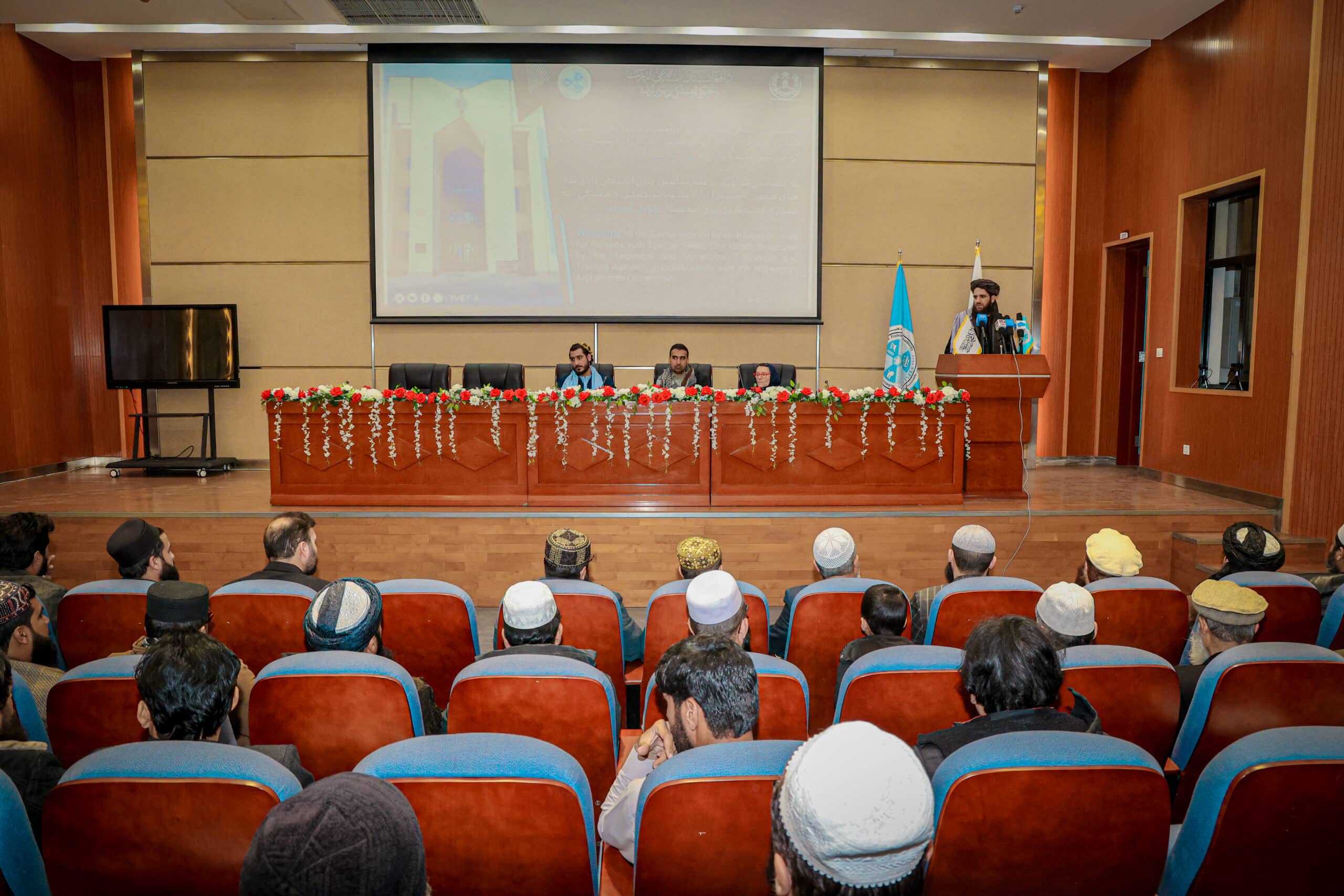
The Norwegian Afghanistan Committee (NAC) and Technical Vocational Education and Training Authority (TVET-A) jointly organised a conference on accessibility of STEM (Science, Technology, Engineering and Mathematics) subjects for persons with visual impairment. The event took place in the TVET conference hall with nearly one hundred participants attending in person and online, including media representatives, TVET employees, teachers from various institutes for the blind and visually impaired individuals from different provinces.
The lecture was delivered online by Professor Filippo Petroni, an expert from Italy and a faculty member at G. D’Annunzio University of Chieti‑Pescara. His presentation focused on new scientific developments in special education, on improving accessibility for learners with visual impairment and on strengthening teaching skills for teachers and professors in the field of special education in sciences.
Abdul Wadood Omar, Director of the Technical and Vocational Education Students Department, expressed his appreciation for this initiative in his opening remarks: “We greatly need opportunities to share scientific experiences and skills,” he said. “We hope NAC will continue organising such essential workshops in the future.”
Following,Francesca Recchia, Head of Advocacy and Communications at NAC, praised TVET’s efforts to make after many years the Kankor exam accessible for students with visual and hearing impairment. She added: “A profound and radical cultural shift is necessary, one that compels us to recognise and value people’s abilities and capacities, regardless of their scale. Whether someone can contribute a lot or only a little, their contribution still matters.”
During his talk, Professor Filippo Petroni discussed the value of science in special education, explaining how accessibility opens doors for learners with visual impairments. He shared his experience in developing tools and specialised methods to support blind students.
“Blind individuals are not incapable; they possess strong learning abilities,” he said. “The challenge lies not in their capacity, but in how accessible education is made for them. Scientific and mathematical graphs and formulas are not just images; they are a language that can be translated into Braille or conveyed through modern assistive tools.”
In the final part of the workshop, teachers and visually impaired participants engaged in a lively question‑and‑answer session. Most of the questions centred on how the discussed methods could be practically implemented in Afghan educational settings. Professor Filippo Petroni agreed to continue the discussion and share with TVET the resources he developed.
To conclude the event, Ghulam Sakhi Wahdat, Head of the Special Education Department at TVET, thanked NAC for organizing the workshop. He called for continued collaboration to ensure that persons with disabilities in Afghanistan can benefit from global advancements and educational facilities. Wahdat also encouraged families across the country to register their children with disabilities in special education centres to ensure they receive the support and opportunities they deserve.
Read more about our work on disability inclusion here and about TVET here.


